

Haunted Room makes its case fast. Pick a room, fall asleep to generate resources, reinforce the door, and place heroes before something unpleasant breaks in. That’s the whole pitch, and it works.
This Haunted Room: Sleep Survivor review is about the harder question that store descriptions avoid: does strategy remain the deciding factor once progression slows, or does paying increasingly determine the pace? Player reviews repeatedly mention expensive progression, paid battle speed, difficult bosses, and gacha pressure. That does not prove every free account eventually becomes stuck, but it does tell you what to watch before time and money start piling up.
The short verdict? Its five-minute defense loop is worth trying for free. Whether Haunted Room keeps its spot on your phone depends on your patience once convenience and progression start asking for money.
Quick Verdict
- Best part: A readable room-defense loop where income, survival time, and damage compete for the same resources.
- Biggest warning: Regional player reviews repeatedly flag pay-to-win pressure, paid speed, repetitive progress, and steep boss walls.
- Bottom line: Try it if you enjoy patient resource play. Skip it if gacha or paying to remove friction ruins a strategy game for you.
Which Haunted Room Game Is This?
The game reviewed here is Haunted Room: Sleep Survivor, published on Google Play under Joy Nice Games. Its Android package ID is com.ygjszsea.google, and the Play listing names JUXIN NETWORK LIMITED as the legal developer. At the time of our research, the game had passed one million Google Play downloads and was also available on Apple’s App Store.
That clarification matters more than usual. A search for “Haunted Room” can lead to at least two unrelated games: noprops’ simple escape game with package ID info.mygames888.hauntedroom, and the PC psychological-horror title Haunted Room: 205. Neither is the hero-collecting room-defense game discussed below.
In Sleep Survivor, your room is both a shelter and a tiny economy. Your character sleeps to produce resources. You spend those resources on the bed, the door, heroes, and defensive facilities while ghosts and urban-legend monsters try to get inside. It borrows the familiar “sleep behind a door while a hunter attacks” concept, then adds collectible heroes, long-term account progression, multiple locations, and gacha systems around it.
That combination is why it sits somewhere between casual tower defense and an idle hero collector. The individual battle is easy to read, but the account surrounding it is built to keep you returning.
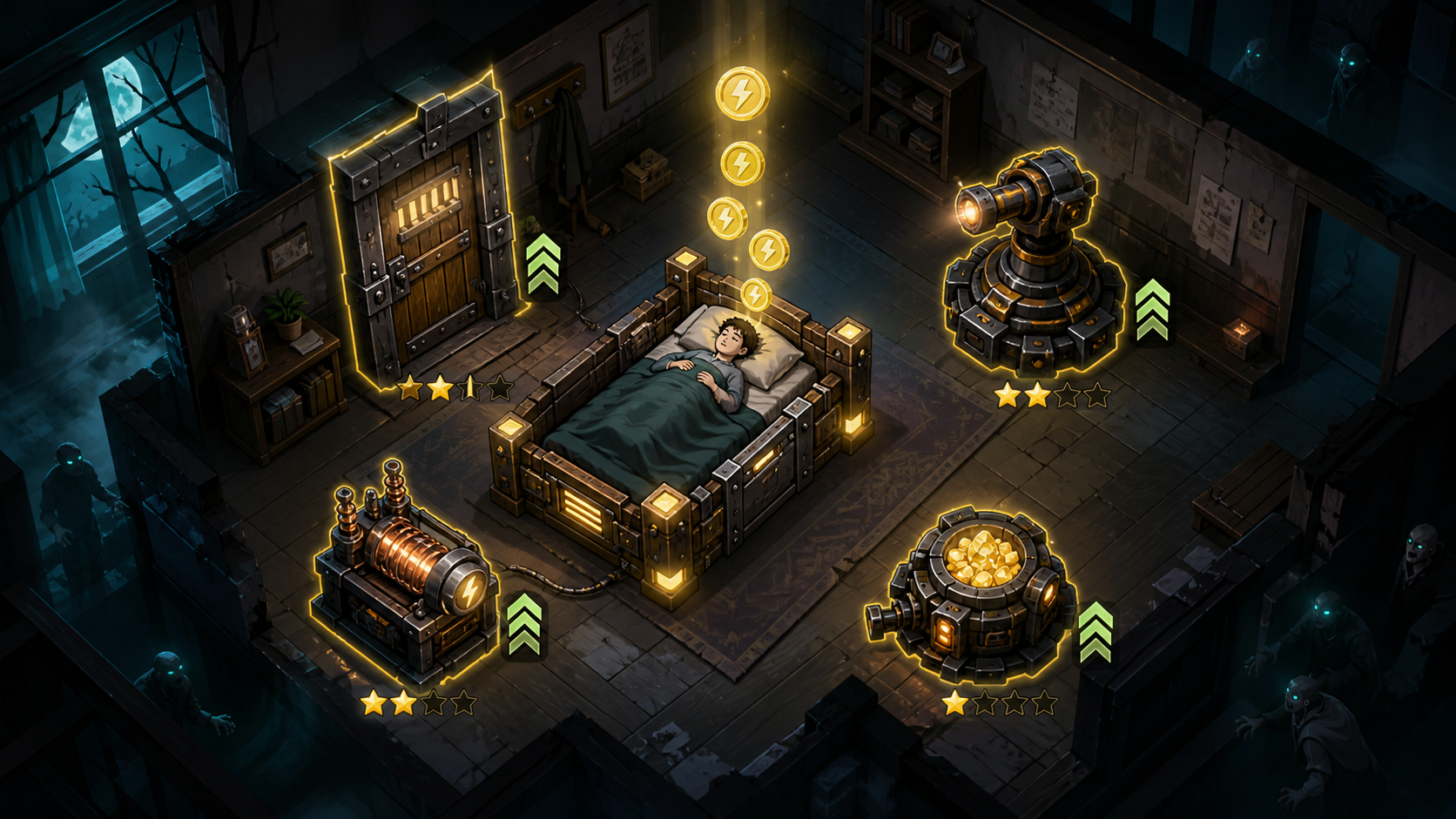
The 5-Minute Loop: Sleep, Upgrade, Survive
Each match begins with a race for a defensible room. Once you settle in, sleeping turns the bed into your main income source. A better bed means faster resource generation, but those resources must also keep the door standing and put enough damage on the field to stop whatever is outside.
This creates three competing clocks. Your economy needs to grow before upgrades become too expensive. Your door needs enough health to buy that growth time. Your heroes and weapons need enough damage to end the threat rather than merely delay it. If one clock falls too far behind, the entire build can collapse quickly.
That’s where the good decisions live. Pour everything into the bed and you may become rich moments before the door breaks. Overbuild the door and you’ll survive without enough damage to finish the stage. Buy attackers too aggressively and your income can stall before the next upgrade tier.
It is a compact version of the resource tension found in larger strategy games such as Worms W.M.D. Mobilize: a simple action is rarely good or bad on its own; timing and opportunity cost decide whether it works. Haunted Room communicates those costs quickly enough for a short phone session.
Why the opening rounds work
The immediate threat gives every upgrade a visible purpose. A thicker door survives longer. A better bed changes how quickly you can respond. A new hero adds damage or another useful combat effect. You do not need a spreadsheet to understand why you lost.
The presentation helps. Haunted schools, hospitals, hotels, trains, offices, and caves give the game a broader identity than one endlessly repeated bedroom. Monsters lean toward gothic chibi rather than realistic gore, so the atmosphere is spooky without making every session exhausting.
There is also more surrounding content than the basic premise suggests. Regional coverage describes story stages, hero development, an endless tower, an arena, and a two-player cooperative activity. Those modes create new reasons to improve the account even when the room-defense foundation remains familiar.
Where the loop begins to drag
That clarity has a downside: repetition. Player reviews say objectives stay similar, account progress slows down, and raw power can matter more than finding a smarter tactic. Tuning a familiar loop can be satisfying. Expect a genuinely new puzzle every stage, though, and the structure wears thin.
This is also where the hero-collector layer changes the character of the game. A loss no longer asks only, “Did I upgrade in the wrong order?” It can also ask whether your roster, star levels, materials, or account bonuses have fallen behind. That ambiguity is central to the free-to-play debate.
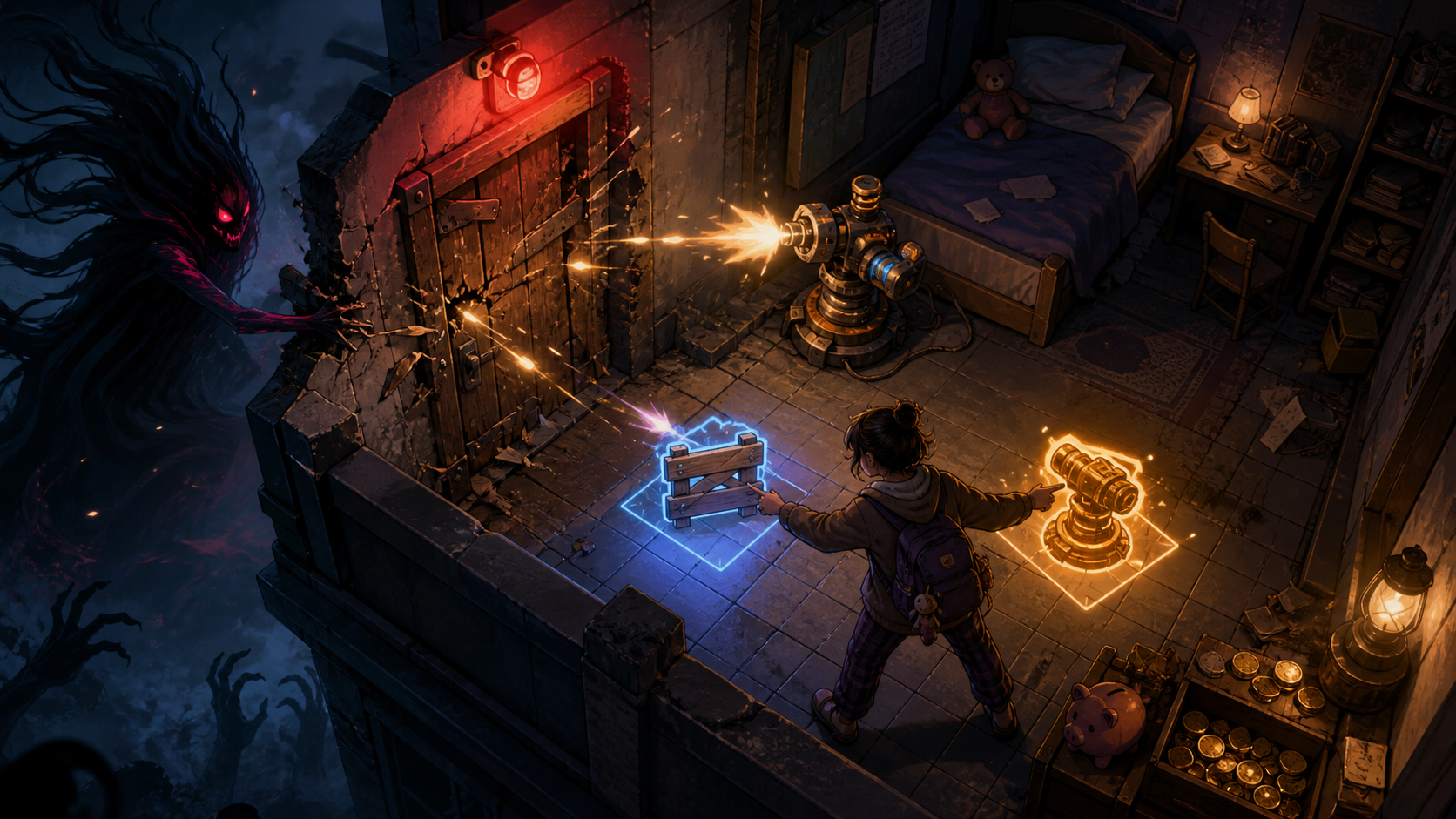
The Real F2P Question: When Does Optional Spending Start Shaping the Game?
Calling a game “pay to win” can hide several different complaints. In Haunted Room, the player feedback points to three separate kinds of pressure, and they do not affect everyone equally.
The first is paying to progress faster. Better heroes, more summons, and additional upgrade resources shorten the time needed to build a strong account. This is standard hero-collector monetization, but it becomes more noticeable when story difficulty rises faster than a free roster.
The second is paying to remove slow pacing. A Singapore App Store reviewer specifically complained that 2x speed was locked behind payment rather than earned through normal progress. That matters because slow battle speed does not make the strategy deeper. It makes repeating familiar stages take longer, turning convenience into part of the product being sold.
The third is feeling pushed to pay at a progression wall. Reviews from several Southeast Asian storefronts describe difficult bosses, expensive events, and story stages that feel designed around stronger purchases. One player still considered the game enjoyable with patience and strategy, while others felt that spending had become more important than planning. That disagreement is useful: the game may not stop every free player at one universal stage, but it can make the free route feel increasingly inefficient.
Play, pay, or skip?
Play free if the five-minute room puzzle is the main attraction and you are comfortable treating account growth as a slow background project. You can enjoy the core decisions without proving that your account can clear every event or keep pace with spenders.
Consider spending only after the game proves its value, not because the first difficult boss creates urgency. Before buying anything, understand whether the benefit is permanent, whether it applies across the content you care about, and whether your server still feels active. A purchase that only moves one short bottleneck is poor value when another wall may sit immediately behind it.
Skip Haunted Room if paid battle speed bothers you, if duplicate heroes and random pulls make progress feel hollow, or if you want skill to be the only meaningful difference between accounts. The game is not hiding its gacha structure. Hoping it will eventually behave like a purely tactical premium game is a recipe for frustration.
The fairest verdict is not “free players cannot win.” We do not have evidence for that universal claim. The evidence supports something more precise: Haunted Room creates enough pressure around pace, power, and difficulty that a free player must be comfortable progressing on the game’s schedule rather than their own.
If you want a strategy game where purchases do not shape a hero roster, our Totally Accurate Battle Simulator review looks at a premium-style battle sandbox with a very different progression model.
Art, Performance, and Server Friction
Haunted Room’s visual identity is one of its strongest decisions. Thick outlines, compact rooms, stylized heroes, and monsters drawn from folklore make the battlefield readable on a small screen. A masked attacker or oversized boss can look threatening without disappearing into a muddy, nearly black environment.
The official listing advertises Android support and Windows availability through Google Play Games, while an iOS version is available from Apple. Third-party listings report Android 5.0 or later, but treat that as version-sensitive rather than a permanent official requirement.
We cannot responsibly give you an FPS number for a Samsung Galaxy A54, OPPO A78, or Vivo Y36 because no device test was performed for this article. Public feedback is mixed rather than reassuring enough to fill that gap with a guess. One regional reviewer reported poor phone optimization compared with games using more detailed assets, while other coverage emphasizes smooth controls. Your safest approach on a mid-range or budget phone is to install through the official store, play through the first busy battles, and check heat, frame pacing, and battery use before making a purchase.
Storage figures are similarly messy. APKPure and Uptodown showed packages of roughly 212-246 MB during research, but their version numbers did not agree. The installed footprint may also increase after resource downloads. Leave more free space than the store’s initial package suggests.
The other technical concern is server friction. Player reviews mention login trouble, requests for server merges, and difficulty adding friends across servers. These are reports, not proof that every region has the same restriction. Still, if co-op or playing with friends is your reason for installing, confirm that everyone can join the same server before anyone spends money.
For a different kind of unsettling multiplayer experience without this exact room economy, our GONE Fishing review covers a horror game built more around playing with a group.
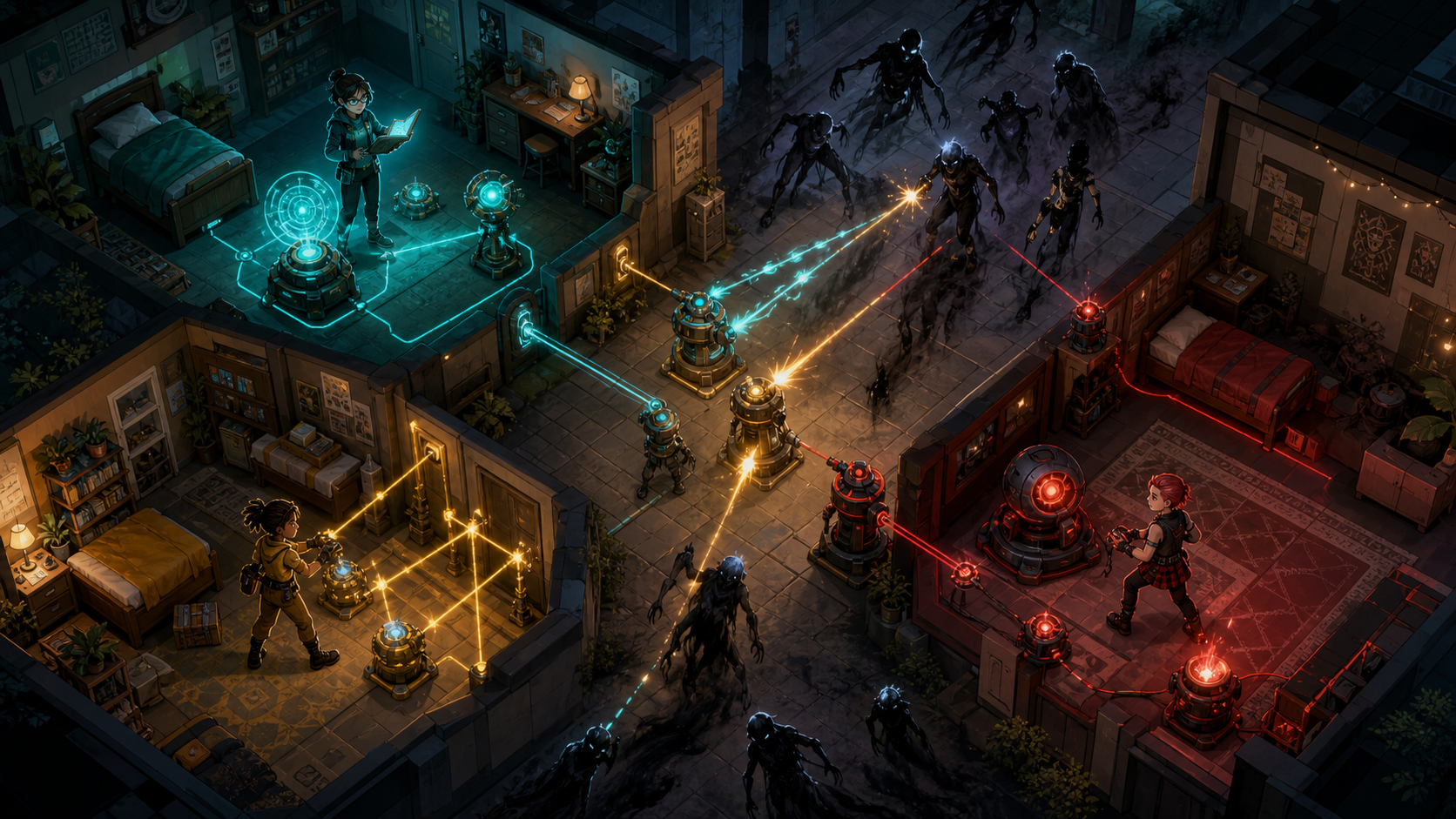
For horror built around watching doors and surviving the night rather than managing a gacha economy, compare it with our Five Nights at Freddy’s APK review.
Five F2P Habits That Delay the Wall
Think of these as resource habits, not a magic build order. Stage rules, balance patches, and your available heroes can all change the right move.
-
Do not upgrade one layer blindly. The common mistake is treating the bed, door, or damage as the only priority. Watch three things instead: how quickly you earn the next upgrade, how long the door survives under current pressure, and whether your team can actually finish the attacker. Improve the layer that is about to fail.
-
Protect scarce summon currency. A visible banner is not automatically a good banner. Learn which combat role your account lacks, read the pity and event terms, and avoid scattering resources across every new hero. Random pulls feel exciting; a coherent roster wins more stages.
-
Treat redeem codes as a bonus, not a progression plan. Codes can provide gold, summon items, stamina, or upgrade materials, but they expire quickly and may be restricted by region or account state. They can smooth an early session. They cannot repair an economy built around impulsive spending.
-
Judge the server before paying. Check whether you can add the friends you intended to play with, whether co-op is accessible, and whether the server appears active. Player complaints about cross-server friendship and merger requests make this check more important than an extra first-day bundle.
-
Set a stop rule before the first wall. Decide what would make the game no longer enjoyable: repeating the same stage for days, buying speed, chasing a specific hero, or paying every event. When that line is crossed, stop. A previous purchase is not a reason to make the next one.
Is Haunted Room Safe to Download?
Use the official Google Play or Apple App Store buttons provided on this page. Both stores carry the exact Haunted Room: Sleep Survivor entity, and the Android package should be com.ygjszsea.google. Checking that package ID protects you from accidentally installing the unrelated noprops escape game.
Google Play says the game contains ads and in-app purchases, including purchases involving random items. Its data-safety section says no data is shared with third parties, no data is collected, information is encrypted in transit, and deletion can be requested. Those statements are supplied by the developer; they are not an independent APKStoreTH privacy or security audit.
We also found third-party APK listings, but their current version and file-size records conflicted. That does not prove either file is malicious. It does mean a repository badge or the word “verified” should not be treated as conclusive evidence that APKStoreTH checked the file ourselves.
For that reason, we are not providing a direct third-party APK button. The official stores are available, carry the correct product identity, and avoid the uncertainty of choosing between mismatched packages.
Our Escape from Ninja Girls APK investigation shows why confirming the exact app identity and official store source matters before sideloading an unfamiliar game.
Frequently Asked Questions
Is Haunted Room: Sleep Survivor free to play?
Yes, it is free to install. Google Play lists ads and in-app purchases, including random-item purchases. You can try the central room-defense loop without paying, but player reports suggest later pace and progression may feel substantially more restrictive.
Is Haunted Room pay to win?
It has meaningful player-reported P2W pressure. Complaints focus on gacha power, hard story or boss stages, paid 2x speed, and expensive events. We cannot verify that every stage is impossible for every free account, so “high pressure” is more accurate than “payment is mandatory.”
Should beginners upgrade the bed or the door first?
There is no universal answer. Upgrade income when the door already buys enough time, reinforce the door when it is close to breaking, and add damage when you can survive but cannot finish the enemy. The weakest of those three systems should guide the next purchase.
Can Haunted Room be played on PC?
Yes. Google Play lists Windows availability through Google Play Games. BlueStacks also offers an emulator route, but that is a separate third-party platform rather than the game’s publisher.
Is this the same as Haunted Dorm or Haunted Room: 205?
No. Haunted Room: Sleep Survivor uses package ID com.ygjszsea.google and adds a hero-collector progression layer to its room-defense concept. Haunted Room: 205 is a separate PC horror game, while Haunted Dorm is another title built around a related sleep-and-defend premise.
Final Verdict: Try the Loop Before You Buy the Pace
Haunted Room is for you if you like compact tower-defense puzzles, visible resource trade-offs, collectible heroes, and horror that looks playful rather than oppressive. The first-session loop earns a fair trial: sleeping for income while a door buckles under pressure is simple, tense, and immediately readable.
Stay free at first. Learn whether the repetition, server structure, battle speed, and hero progression fit your patience before buying a shortcut. A bundle can accelerate an account, but it cannot make an irritating core pace enjoyable.
Skip it if paid convenience already feels like a red flag, if gacha makes victories less satisfying, or if you want every loss to be solved by better tactics alone. Player reports make it clear that monetization is not a decorative menu sitting outside the game; it shapes how progress feels.
The five-minute defense loop earns an install. The monetized pace decides whether Haunted Room earns anything more. Use the official store buttons on this page so you get the right game, not one of the unrelated titles sharing its name.
Pros & Consข้อดี & ข้อเสีย
How to Download (Safe Guide)วิธีดาวน์โหลด (คู่มือปลอดภัย)
Haunted Room: Sleep Survivor Review: Fun for 5 Minutes, Fair for F2P? is available on the following platforms. Follow our safe download guide for each store.Haunted Room: Sleep Survivor Review: Fun for 5 Minutes, Fair for F2P? พร้อมให้บริการบนแพลตฟอร์มต่อไปนี้ ทำตามคู่มือดาวน์โหลดอย่างปลอดภัยสำหรับแต่ละร้านค้า