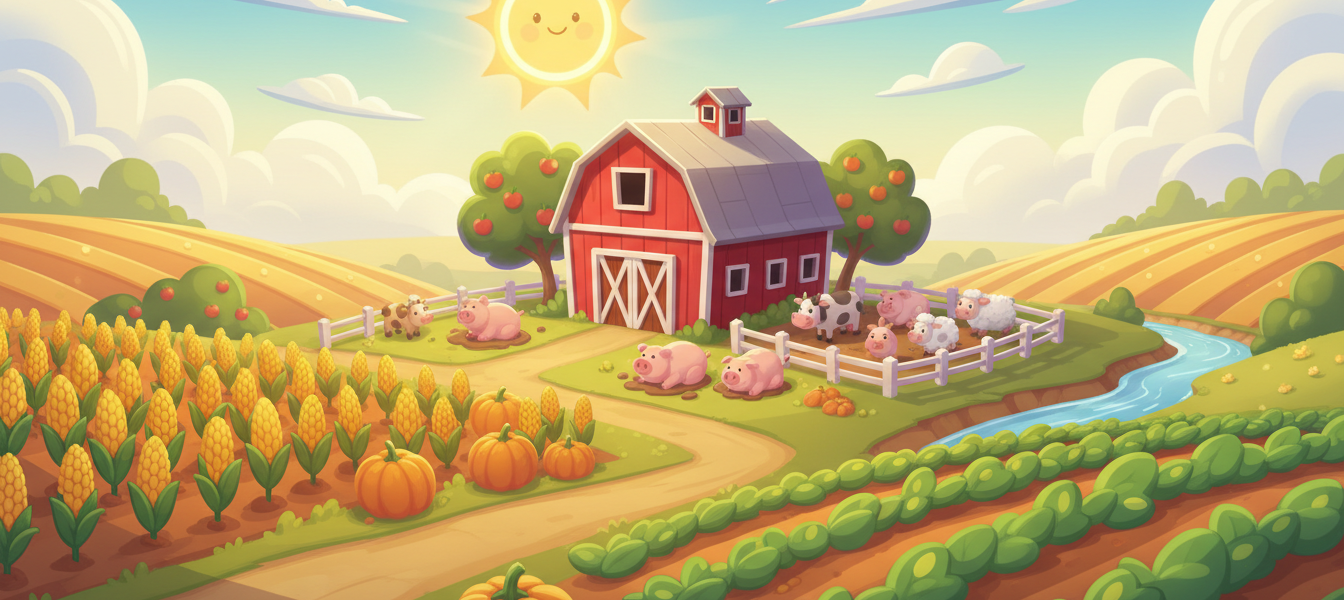

If you want a farming game that actually has a story worth following — not just crops to water — Family Farm Adventure is the one to try first. It’s the highest-rated pick in its category, built by Century Games around a genuinely single-player structure: no neighborhoods, no live trading economy, just you, a destroyed flower farm, and two mysterious islands full of puzzles.
This pick is featured in our 5 Best Offline Farming Simulation Games for Android roundup — see how it stacks up against the rest of the list.
Quick Verdict:
– Best for: players who want a story-first farm sim with real characters and puzzles, not just resource management
– Skip if: you don’t want to think about energy management — this game’s pacing is built around it
– Rating: 4.6/5 on Google Play (554,000+ reviews, 10M+ downloads)
What is Family Farm Adventure?
Family Farm Adventure, from Century Games, puts you in charge of rebuilding a flower farm on a tropical island after an earthquake destroys it. Alongside photographer Felicia and archaeologist Toby, you split your time between tending crops and animals at home and exploring mysterious islands to solve puzzles, uncover treasures, and meet a cast of villagers and wild animals along the way.
It’s earned Google Play’s Editors’ Choice badge and sits at 4.6 stars from over 554,000 reviews with 10 million-plus installs — the highest rating of any game in this offline farming category. The story is genuinely the draw here: quests tie into a running narrative about restoring the farm and preparing for the Festival of Flowers, rather than farming existing purely as a numbers game.
Critically for this list, the game’s own description never mentions neighbors, visiting other players, or a live trading economy — it’s built and marketed as a single-player experience from the ground up, which is exactly the trap this roundup warns about avoiding with other “farm simulator” games.

Gameplay & Core Mechanics
The core loop splits cleanly into two halves. At home, you plant and harvest crops, raise farm animals, cook with what you produce, and decorate your growing flower farm with items you find on your travels. Away from home, you send Felicia and Toby off to explore tropical islands, where the gameplay shifts into puzzle-solving — clearing overgrown paths, uncovering hidden treasures, and meeting quirky villagers and wildlife who send you on side quests. Compared to a mechanically deeper title like Farming Simulator 23 Mobile, which leans hard into equipment and field-management realism, Family Farm Adventure keeps its farming simple on purpose so the story and puzzles stay front and center.
Where the game earns its reputation is the writing and pacing of that story — even players leaving critical reviews consistently praise the narrative and visual polish rather than the underlying content. Ian Thomas, a long-time player, put it simply: it’s “light and fun with a great story,” and he specifically noted he never needed to spend real money to keep enjoying it.
The catch, and it’s a real one, is the energy system that gates almost every action. Clearing a single obstacle on an island can cost anywhere from 30 to 130 energy, while energy itself regenerates slowly — around one point every 90 seconds by several accounts. Multiple reviewers describe sessions lasting only three to five minutes before they’re locked out and waiting, and the game does push optional “passes” and bundles that speed things up. One frustrated reviewer counted more than 14 simultaneous pass offers stacked on their screen at once. This isn’t a hidden flaw — it’s the central design tension of the whole game, and it’s worth knowing about before you start.
To Century Games’ credit, energy isn’t a hard paywall. Multiple long-term players report finishing quests, completing daily goals, and trading with the in-game merchant to top up energy without ever paying, and the developer actively responds to reviews suggesting exactly this. It just means the pace is genuinely slower if you play free, which fits a “little bit each day” style of play better than marathon sessions.

The Energy System: What to Expect Before You Dive In
Because this is the single biggest factor in how much you’ll enjoy the game, it deserves its own honest breakdown. Every meaningful action — clearing debris, chopping a tree, digging up an obstacle — costs energy, and energy caps out at a relatively low number that refills gradually over real time. Early levels feel generous; by the time you’re a dozen or so levels in, several reviewers report the math stops adding up in the player’s favor without either patience or purchases.
The practical upside is that this makes the game genuinely suited to short, repeated check-ins rather than long sessions — open it a few times a day, clear what energy allows, and let the rest refill. Treated that way, most of the frustration in the negative reviews disappears, because you’re not fighting the system, you’re working with its actual rhythm. Treated as a game you sit down and binge for an hour, it will frustrate you fast, and that mismatch of expectations is really what’s behind most of the one and two-star reviews.
If you’ve played other Century Games titles (Family Farm Seaside, Family Farm Merge), the pattern will be familiar — this studio consistently builds around energy-gated short sessions rather than open-ended play, and Family Farm Adventure is no exception.
Is Family Farm Adventure Worth Playing in 2026?
Yes, with the expectation set correctly. This is the highest-rated game in its category for good reason — the story is genuinely engaging, the art direction is polished, and it does exactly what it promises: a single-player farming-and-adventure game with no live-service social layer forced on top of it. Players who go in expecting a slow-burn, few-minutes-at-a-time experience consistently rate it highly and stick with it for years, based on the volume of long-tenured reviewers still actively playing.
Where it falls short is for anyone hoping to binge it in long sessions or clear content quickly without spending. The energy system will actively fight that playstyle, and no amount of goodwill toward the story will fix that mismatch. If that’s a dealbreaker, Harvest Town or Farming Simulator 23 Mobile — both also on this list — offer less energy-gated pacing.
For everyone else who wants an actual narrative reason to keep farming, this remains the strongest pick on the list, and its 4.6-star rating across more than half a million reviews backs that up.
Tips for New Players
- Play in short bursts, several times a day. The energy system rewards frequent short check-ins far more than long sessions — treat it like checking a mailbox, not settling in for an hour.
- Prioritize story quests over side content early on. Main story missions tend to give the best energy and reward payouts relative to their cost.
- Don’t buy the first pass offer you see. Play a few days free first so you understand your actual energy rhythm before deciding whether any purchase is worth it.
- Use the in-game trader for energy refills. Several long-term free players confirm this is a legitimate way to top up without spending, even if it’s slower.
- Watch optional ads when they’re offered. They’re skippable in most cases and give real rewards — several reviewers note this is the most effective free way to keep pace.
- Don’t skip the villager and animal interactions. They’re not just flavor — completing their requests is one of the more reliable energy-efficient ways to progress.
FAQ
Is Family Farm Adventure really free to play?
Yes, the base game and story content are free. In-app purchases ranging from $0.99 to $99.99 exist for passes and bundles that speed up progress, but multiple long-term players report finishing content without spending.
Do I need an internet connection to play?
The game’s core farming and story content is single-player and can be played offline, though some features (like the merchant/trading system or reviewing update notes) may prompt a connection. If having zero reliance on a connection matters more to you than story depth, Farm Day Village Farming is built specifically around true offline play and is worth comparing.
Why does the game feel slow after a few days?
This is almost always the energy system — action costs rise relative to your regeneration rate as you level up. It’s a known, consistently reported pacing curve, not a bug.
Is this game appropriate for kids?
It carries an “Everyone” content rating on Google Play, and the content itself (farming, puzzles, light adventure) is family-friendly. Parents should be aware of the in-app purchase prompts, which can appear frequently.
Final Verdict
Family Farm Adventure earns its 4.6-star rating and Editors’ Choice badge honestly — it’s the most story-rich, best-reviewed pick in this offline farming category, and the single-player structure means you’re never pressured into a social economy you didn’t ask for. Just go in knowing the energy system sets the pace, play it in short daily sessions rather than marathons, and it’s an easy recommend. If you’d rather start with something more old-school and lighter on downloads, Farming Simulator 20 is still a solid, cheaper alternative worth comparing before you commit.
Pros & Consข้อดี & ข้อเสีย
How to Download (Safe Guide)วิธีดาวน์โหลด (คู่มือปลอดภัย)
Family Farm Adventure Review 2026: Story-Driven Farming Done Right is available on the following platforms. Follow our safe download guide for each store.Family Farm Adventure Review 2026: Story-Driven Farming Done Right พร้อมให้บริการบนแพลตฟอร์มต่อไปนี้ ทำตามคู่มือดาวน์โหลดอย่างปลอดภัยสำหรับแต่ละร้านค้า